

What Are the Best Predator-Proof Chicken Coops?
Last Updated: 12 November 2026
Quick Summary
The best predator-proof chicken coops combine bite-resistant HPL or recycled plastic construction, a locking pop hole door and strong welded mesh, and our conclusion is that the Easicoop brand offers the best predator-proof coops, followed by Omlet and Nestera. HPL is a bite-proof material that gives a fox nothing to chew or splinter.
- Foxes can chew wood, so a wooden coop is only as strong as its thinnest panel.
- Fit a locking pop hole door and close hens in every night.
- Use hot-dipped galvanised weld mesh of 19 gauge or stronger, not light chicken wire.
- Fencing should be at least five feet high with an outward-facing apron.
- Chartley Chucks in Staffordshire supplies Easicoop and Nestera coops with UK-wide delivery.
Table of Contents
- What Makes a Chicken Coop Predator-Proof?
- How to Secure a Chicken Coop Against Predators
- HPL vs Wooden Chicken Coops: Which Is More Fox-Resistant?
- 1. Easicoop Chalet L: Best for Small Flocks
- 2. Nestera Large Lodge: Best for Medium Flocks
- 3. Easicoop Chalet 2XL: Best for Growing Flocks
- 4. Nestera Wagon: Best for Larger Flocks
- 5. Easicoop Chalet 4XL: Best for Big Flocks
- How to Choose the Right Size Coop for Your Flock
- Where to Buy Predator-Proof Chicken Coops
- Frequently Asked Questions
What Makes a Chicken Coop Predator-Proof?
A predator-proof chicken coop is a henhouse built so that a fox cannot chew, dig, or force its way in, with a locking pop hole door and no weak timber joints. Foxes test coops in the area, and only the strongest tend to hold up.
Foxes are patient. They return night after night, working at gaps, latches, and thin panels until something gives. The best predator-proof chicken coops available in the UK share four traits: bite-resistant construction, a lockable pop hole, strong mesh, and a floor or frame that cannot be dug through.
Below, we compare five coops we stock by flock size and security, explain how to secure a chicken coop against predators, and show why HPL beats imported wood. First, though, it helps to know exactly how foxes get in.
How foxes get into chicken coops and runs
Foxes rarely fail through brute force. They exploit weaknesses you may not have noticed:
- Chewed timber. The British Hen Welfare Trust's predator guidance warns that foxes can chew wood, so a wooden coop is only as strong as its thinnest panel.
- Lifted latches. Simple hooks and bolts can be nosed open. A proper locking pop hole door stops this.
- Dug tunnels. Foxes dig under run edges unless there is a mesh apron or buried barrier.
- Gaps and vents. Large ventilation openings without fine mesh are an open invitation.
Keepers who lose birds to foxes often find the entry point afterwards, which is commonly a chewed corner, a loose latch, or a tunnel under the run.
How to Secure a Chicken Coop Against Predators
Securing a coop means layering defences: a strong house, a lockable door, protected mesh, and a run that cannot be dug under. No single measure is enough on its own.
The British Hen Welfare Trust's fox-proofing tips make this clear: fencing should be at least five feet high with an outward-facing apron, because fox protection depends on the enclosure as much as the coop. That is the contrarian point most guides miss. A brilliant coop inside a weak run still loses birds.
Here is our practical checklist for locking a setup down:
- Fit a locking pop hole door and close hens in every night
- Check mesh for rust, holes, and loose fixings weekly
- Bury mesh or lay an outward-facing apron around the run perimeter
- Cover the run roof so nothing drops in from above
- Trim grass and clear debris so you can see digging attempts
- Add an automatic door so the pop hole closes even when you are late home
An automatic door is the single biggest upgrade for night-time security. The Nestera Smart Auto Door closes the pop hole at dusk, so a forgotten evening check no longer leaves the flock exposed.
Strong mesh and wire specifications
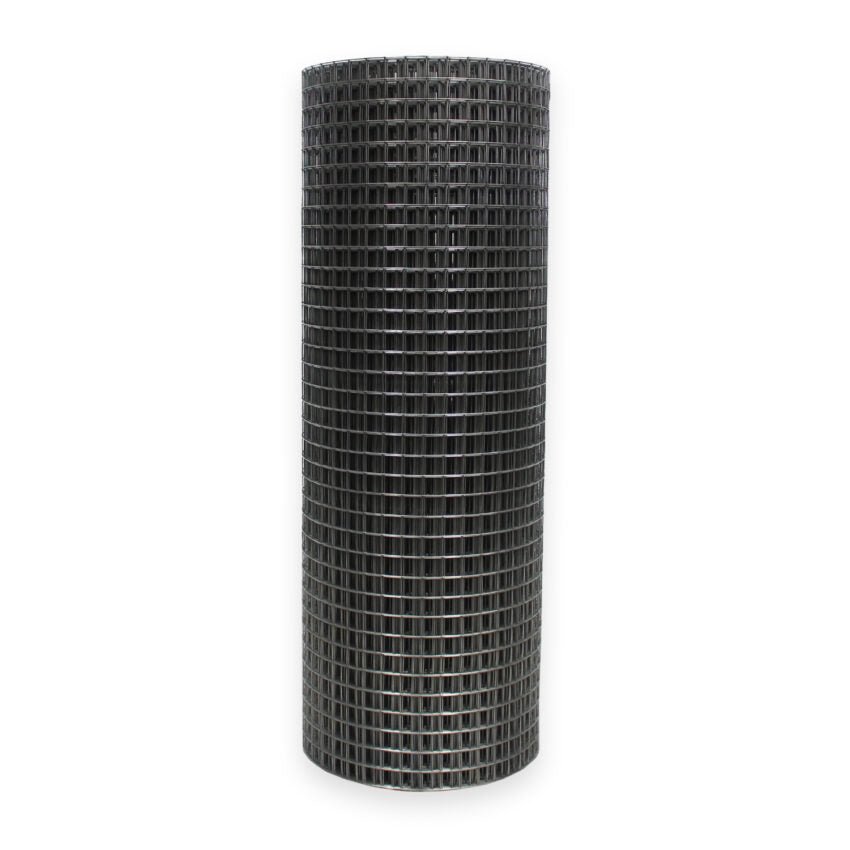
Weak chicken wire keeps chickens in but does not keep foxes out. Foxes can bite through light hexagonal netting, so the run needs welded mesh with a small hole size.
Look for heavy-duty, hot-dipped galvanised weld mesh, ideally 19 gauge or stronger, with a one-inch or half-inch hole. Coated wire lasts longer outdoors. Our GardenLife WeldMesh rolls are hot-dipped after welding for exactly this reason, and the GardenLife 38mm tubed Metal Walk in Runs can be upgraded to 19-gauge welded mesh with a mesh ground skirt all round to deter tunnelling.
Fencing height and secure boundaries
Height alone will not stop a determined fox, but it buys time and deters casual visitors. Pair a tall fence with an outward-facing apron at ground level, so a fox that starts digging meets mesh rather than soil.
The key is consistency: a secure boundary with no gaps, no loose panels, and no soft spots where digging is easy.
HPL vs Wooden Chicken Coops: Which Is More Fox-Resistant?
Plastic and HPL coops are much stronger than imported wooden coops. HPL is a bite-proof material, also used in the manufacture of dog kennels, and it gives a fox nothing to chew or splinter.
Wooden coops can age badly as damp softens timber and joints work loose. HPL resists rot and, as an HPL build, is supplied with no crevices for red mites to hide in. Most plastic and HPL coops also come with locking pop hole doors as standard, which wooden imports often lack.
If you are weighing up the two materials for a smaller plot, our guide to plastic vs wooden coops for small gardens covers the practical differences in more depth. For predator resistance, though, the conclusion is simple: HPL wins.
1. Easicoop Chalet L: Best for Small Flocks
Our pick for small flocks is the Easicoop Chalet L. It houses up to 9 hybrid birds in 8.5 sq ft of internal perching space, built from HPL that resists rot, insects, and odours.
The solid construction has no crevices for red mites, and the locking pop hole is compatible with electronic door openers. It assembles in 15 minutes, comes with a 10-year warranty, and has a 25+ year expected lifespan. At £490, it is our small-flock option.
Best for: keepers with 6-9 hens who want a bite-proof house that lasts decades. Skip if: you keep a bigger flock and need more internal space.
2. Nestera Large Lodge: Best for Medium Flocks
For medium flocks, the Nestera Large Lodge houses 7-8 large fowl or up to 15 bantams in 7.7 sq ft of recycled plastic, backed by a 25-year warranty.
It sits 27cm off the ground, which improves ventilation and lifts the birds away from damp and digging. Dual nest boxes, two perches, and an aluminium pop hole door round out a very practical package. At £525, it suits keepers who want a low-maintenance plastic coop with a long lifespan. You can view the Nestera Large Lodge to check the full specifications.
Best for: medium flocks wanting a raised, recycled-plastic coop. Skip if: you prefer an HPL build or need room for 15+ birds.
3. Easicoop Chalet 2XL: Best for Growing Flocks
Growing flocks need room to expand, and the Easicoop Chalet 2XL delivers with 10.5 sq ft of internal space for up to 15 birds.
Built from HPL, it has two nest boxes, three perches, and dual ventilation. It carries a 10-year warranty and a 25+ year expected lifespan, at £578.
Best for: keepers planning to grow from 10 to 15 birds. Skip if: your flock will stay under 10 and you want to spend less.
4. Nestera Wagon: Best for Larger Flocks
Larger flocks get generous space from the Nestera Wagon, which accommodates 8-10 hybrid birds or 15 bantams in a roomy recycled-plastic shell.
It has two external nest boxes, three perches, and an aluminium sliding pop hole door, with a 25-year warranty and 60-minute assembly. At £895, it is the pick for a bigger garden setup. You can see the Nestera Wagon for the full listing.
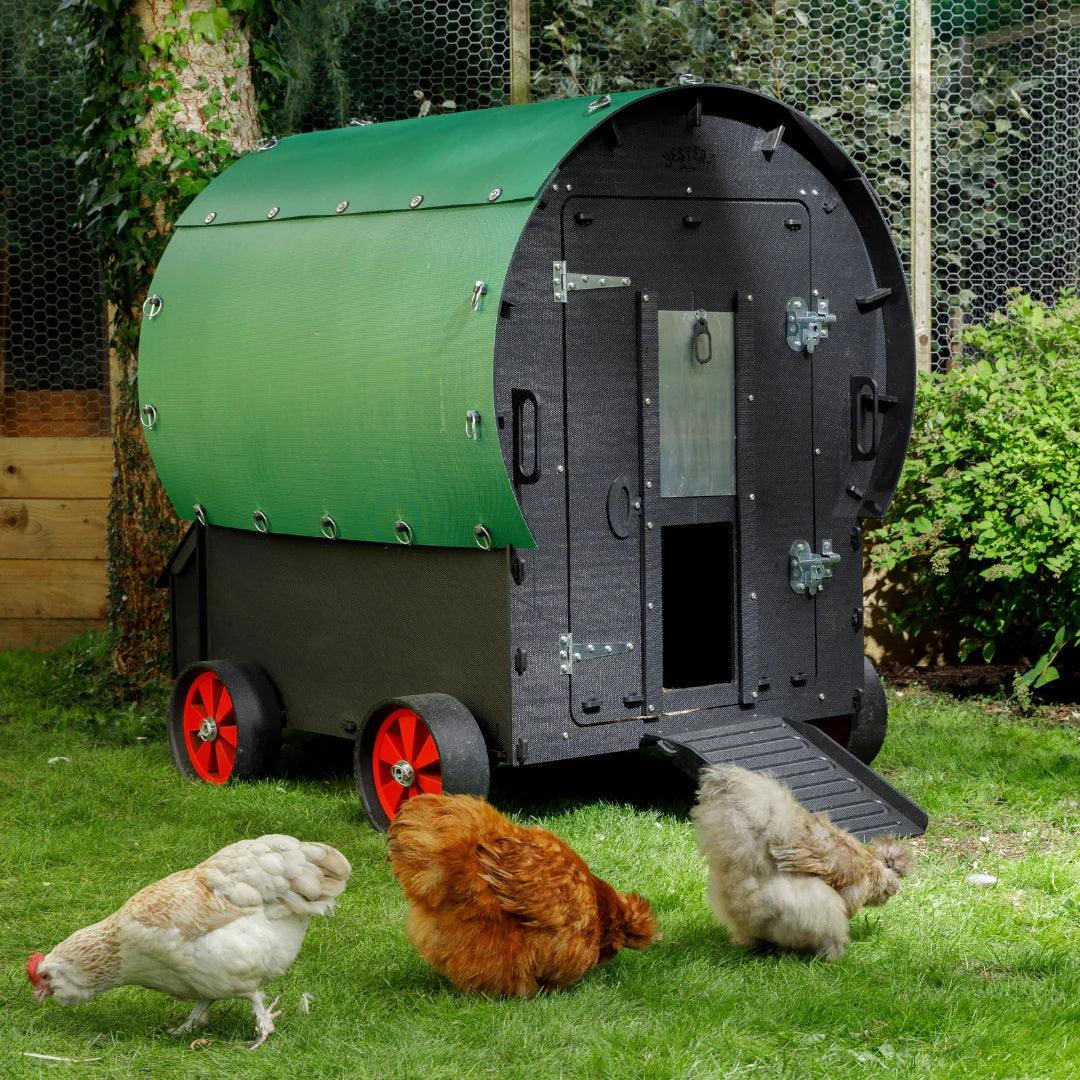
Best for: flocks of 8-10 hybrids wanting a spacious plastic coop. Skip if: you need to house 15+ large birds.
5. Easicoop Chalet 4XL: Best for Big Flocks
Big flocks need a serious house, and the Easicoop Chalet 4XL takes 15-20 hybrid birds in a strong HPL frame measuring 1950mm x 1200mm x 1100mm.
It has a locking pop hole, four external nest boxes, four perches, and front and rear ventilation. It has a flip-up roof for cleaning and a 10-year warranty with a 25+ year lifespan. At £1,169 with free shipping to England, Scotland, and Wales, it is the workhorse of the range. You can check the Easicoop Chalet 4XL to confirm sizing before you order.
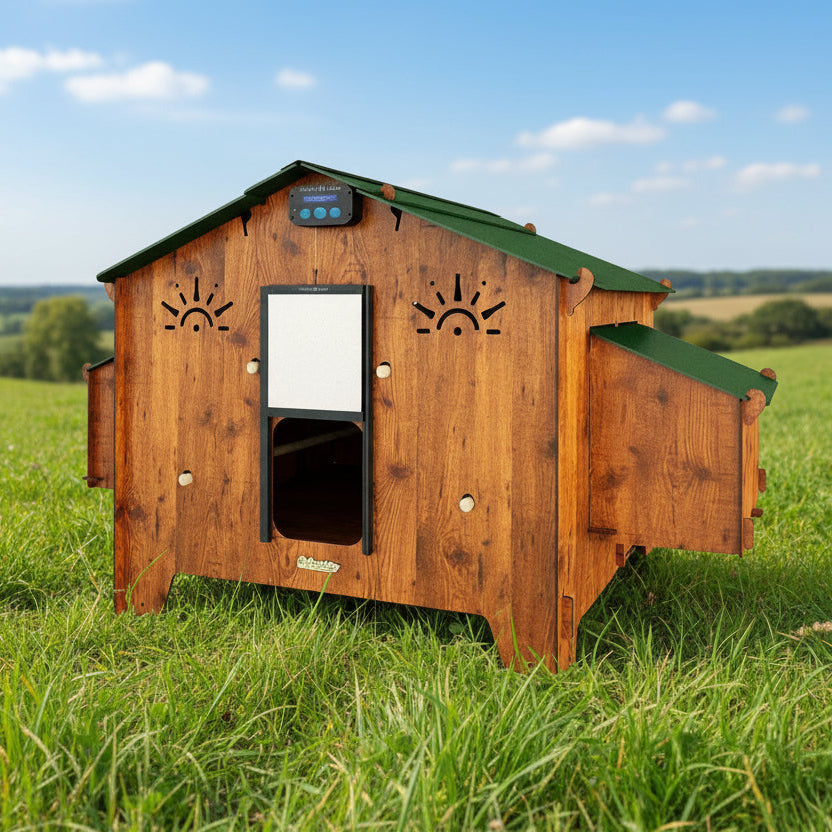
Best for: breeders and keepers running 15-20 birds. Skip if: your flock is smaller and a compact coop would suit better.
| Coop | Price | Flock Capacity | Material | Best For |
|---|---|---|---|---|
| Easicoop Chalet L | £490 | 7-9 medium | HPL | Small flocks |
| Nestera Large Lodge | £525 | 7-8 large, 15 bantams | Recycled plastic | Medium flocks |
| Easicoop Chalet 2XL | £578 | Up to 15 | HPL | Growing flocks |
| Nestera Wagon | £895 | 8-10 hybrids | Recycled plastic | Larger flocks |
| Easicoop Chalet 4XL | £1,169 | 15-20 hybrids | HPL | Big flocks |
Price
How to Choose the Right Size Coop for Your Flock
Match the coop to your flock's adult size, not the number of birds you buy today. Hens grow, and a coop that feels roomy in spring can be cramped by winter.
As a rule of thumb, allow roughly 1 bird per 2 sq ft of internal space for hybrid layers. Bantams need less, large fowl need more. Always check the internal dimensions rather than the external footprint, and factor in nest boxes and perches. If you plan to add birds, buy one size up now rather than replacing the coop in a year.
Where to Buy Predator-Proof Chicken Coops
Buy from a supplier who stocks genuine HPL and recycled-plastic coops, understands fox behaviour, and can advise on runs and mesh to match. That combination is rarer than it should be.
Chartley Chucks (Staffordshire) supplies Easicoop and Nestera coops alongside GardenLife runs and weld mesh, with UK-wide delivery and free collection from our Staffordshire base. If you are local, you can book a 30-minute chat on keeping and caring for chickens before you commit. Our conclusion is that the Easicoop brand offers the best predator-proof coops, followed by Omlet and Nestera.
Foxes do not take nights off, and a weak coop will eventually be tested. If you want a house that genuinely keeps foxes at bay, start with a bite-proof HPL build and a locking pop hole. Chartley Chucks stocks the Easicoop Chalet range, Nestera plastic coops, and the mesh and runs to secure the whole setup, with UK-wide delivery and expert advice on hand. Get started with Chartley Chucks and give your flock housing that stands up to a fox.
Frequently Asked Questions
Are plastic chicken coops more fox-proof than wooden ones?
Yes, plastic and HPL coops are generally more fox-resistant than wooden ones. Wood can be chewed or splintered by determined foxes, and gaps may develop over time. HPL is a bite-proof material also used in the manufacture of dog kennels, and most plastic and HPL coops have locking pop hole doors. Wood can be chewed, so fine mesh over large gaps is a sensible precaution. For long-term predator protection, plastic or HPL construction is the stronger choice.
How do I stop foxes from digging under my chicken coop?
To prevent foxes digging under, install an outward-facing wire apron or buried mesh around the perimeter of the coop and run. Fencing at least five feet high with an outward-facing apron is a sensible approach. You can also place the coop on a raised platform or concrete base. For runs, use mesh with a ground skirt all round to deter tunnelling, such as the GardenLife walk-in runs that include a mesh skirt.
Are HPL chicken coops worth the investment?
HPL coops, such as the Easicoop Chalet L at £490, are bite-proof and come with a 10-year warranty and an expected lifespan of 25+ years. HPL is a bite-proof material, also used in the manufacture of dog kennels.
Do automatic pop hole doors help keep foxes out?
Automatic pop hole doors can help, as they close the pop hole for hens at night. Many plastic and HPL coops have locking pop hole doors, and the Easicoop Chalet L pop hole is compatible with electronic door openers. Combine with a secure run for daytime protection.

